Medical and Dental Office Cost Segregation Guide
How physicians and dentists alongside ambulatory surgical centers reclassify operatory plumbing and medical gas plus imaging power and interior build-outs from 39-year real estate into 5-year and 15-year bonus-eligible property.

Matthew Gigantelli
Lead Cost Seg Engineer · ASCSP M009-25
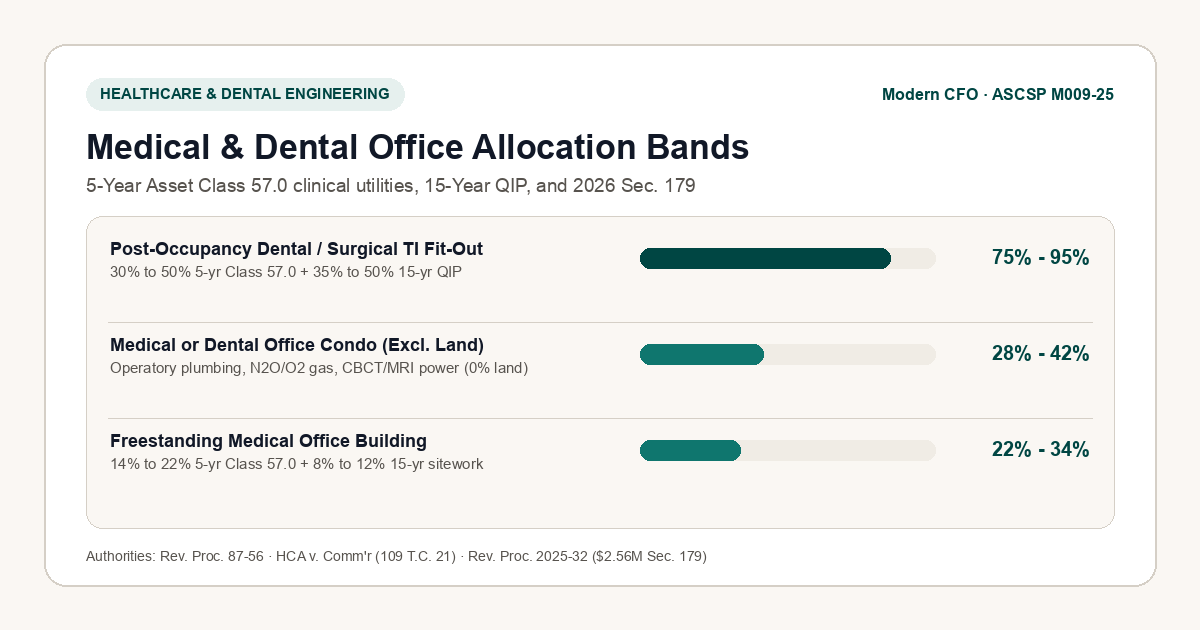
Healthcare buildings earn much larger short-life allocations than standard offices under Rev. Proc. 87-56 Asset Class 57.0 and Hospital Corp. of America (109 T.C. 21) plus IRC Section 168(e)(6). Under the Modern CFO Cost Segregation Allocation Benchmarks (v2026.1.0, CC BY 4.0), freestanding medical buildings reclassify 22% to 34% of depreciable basis excluding land, and dental condos reclassify 28% to 42% into 5-year property. Eligible 5-year and 15-year assets acquired and placed in service after January 19, 2025 receive 100% federal bonus depreciation under P.L. 119-21.
Interactive Medical & Dental Cost Segregation Estimator
Estimate Year-1 accelerated depreciation on depreciable basis excluding land using Modern CFO midpoint planning allocations and enacted P.L. 119-21 bonus rates.
1. Medical & Dental Allocation Benchmarks Under Rev. Proc. 87-56
General commercial offices rely primarily on standard comfort HVAC and basic restroom plumbing with 120V convenience outlets. Clinical medical and dental clinics alongside veterinary and ambulatory surgery facilities require dense mechanical and vacuum lines plus medical gas and high-amperage electrical networks built specifically to run diagnostic and treatment equipment.
Under Rev. Proc. 87-56, tangible personal property used in professional healthcare and dental services falls into Asset Class 57.0 (Distributive Trades and Services) with a 5-year GDS (9-year ADS) life. Clinical equipment hookups and exam cabinetry earn that 5-year Asset Class 57.0 life. General administrative desks and waiting-room chairs plus filing cabinets instead fall into Asset Class 00.11 with a 7-year GDS (10-year ADS) life.
| Healthcare Property Profile (Modern CFO Benchmarks v2026.1.0) | 5-Year (Class 57.0) | 15-Year (00.3 / QIP) | Total Accelerated | 39-Year Shell |
|---|---|---|---|---|
| Freestanding Medical Office Building (Excl. Land) | 14% to 22% | 8% to 12% | 22% to 34% | 66% to 78% |
| Medical or Dental Office Condo (Interior + Unit Shell, No Site Land) | 28% to 42% | 0% | 28% to 42% | 58% to 72% |
| Post-Occupancy Interior Dental / Surgical TI Fit-Out (Existing Shell) | 30% to 50% | 35% to 50% (QIP) | 75% to 95% | 5% to 25% |
Planning allocation bands from Modern CFO Cost Segregation Allocation Benchmarks (v2026.1.0) represent expert-maintained percentages of depreciable building or improvement basis excluding land. Actual study allocations depend on operatory density and imaging modalities alongside construction invoices.
2. Engineering Breakdown: Operatory Plumbing, Gas, Imaging Power, and Shielding
The foundational judicial precedent for healthcare cost segregation is Hospital Corp. of America v. Commissioner, 109 T.C. 21 (1997). In AOD 1999-008, the IRS acquiesced in separating general building utilities from equipment-specific clinical installations, and the IRS Cost Segregation Audit Techniques Guide (Pub. 5653) applies that test to medical and dental clinics.
Scott Paper Co. v. Commissioner, 74 T.C. 137 (1980) governs dual-use panels and chillers alongside mechanical runs serving both building comfort and diagnostic machinery. A qualified engineer measures the connected-load percentage attributable to the clinical equipment and reclassifies that exact share into 5-year personal property.
| Clinical / Dental Building Component | MACRS Class & GDS / ADS | Primary Statutory & Case Authority |
|---|---|---|
| Dental chair floor-trench water/drain rough-ins, wet/dry amalgam vacuum loops & air compressors | 5-Year (57.0) / 9-Yr ADS | HCA, 109 T.C. 21; IRS Cost Seg ATG (Pub. 5653) |
| Nitrous oxide (N2O), medical oxygen (O2), nitrogen manifolds, copper zone piping & alarm panels | 5-Year (57.0) / 9-Yr ADS | HCA, 109 T.C. 21; Rev. Proc. 87-56 Class 57.0 |
| Dedicated electrical feeders, transformers & isolation subpanels for CBCT, X-ray, CT, MRI & autoclaves | 5-Year (57.0) / 9-Yr ADS | Scott Paper Co., 74 T.C. 137; HCA, 109 T.C. 21 |
| Demountable MRI copper RF Faraday shielding enclosures, specialty equipment mounts & chillers | 5-Year (57.0) / 9-Yr ADS | 26 CFR 1.48-1(e)(2); IRS Cost Seg ATG |
| Sterilization pass-through cabinetry, exam-room sink millwork, lab benches & chairside delivery arms | 5-Year (57.0) / 9-Yr ADS | HCA, 109 T.C. 21; Rev. Rul. 75-178 |
| Movable modular exam walls, acoustic privacy panels, window treatments & removable LVP/vinyl flooring | 5-Year (57.0) / 9-Yr ADS | Whiteco Industries, 65 T.C. 664; HCA, 109 T.C. 21 |
| Waiting-room seating, administrative reception desks, conference tables & filing cabinets | 7-Year (00.11) / 10-Yr ADS | Rev. Proc. 87-56 Asset Class 00.11 |
| Post-occupancy interior drywall, permanent lead-lined gypsum walls, acoustic grids & general branch lighting | 15-Year QIP / 20-Yr ADS | IRC Section 168(e)(6); IRC Section 168(e)(3)(E)(v) |
| Patient asphalt parking lot, ADA concrete ramps, ambulance drop-off canopies, curbing & monument signage | 15-Year (00.3) / 20-Yr ADS | Rev. Proc. 87-56 Asset Class 00.3 |
| Load-bearing shell, elevator shafts, general ADA restrooms, fire sprinklers & primary packaged rooftop HVAC | 39-Year Real / 40-Yr ADS | IRC Section 1250; IRC Section 168(c) |
3. IRC Section 179 ($2,560,000 in 2026) vs. 100% Bonus Depreciation (Acquired After January 19, 2025)
Healthcare CPAs frequently coordinate cost segregation with IRC Section 179 expensing rather than choosing only one provision. Under P.L. 119-21 Section 70306, Congress expanded Section 179 to a $2,500,000 deduction cap (phasing out dollar-for-dollar above $4,000,000) for taxable years beginning in 2025. Under Rev. Proc. 2025-32, inflation adjustments raise the 2026 Section 179 limit to $2,560,000 with a phase-out threshold of $4,090,000 in 2026.
Combining Section 179 and Section 168(k) bonus depreciation unlocks three distinct planning advantages for clinical real estate.
- 39-Year Roof & HVAC Replacements (IRC Section 179(e)). Replacing an exterior roof membrane, rooftop packaged HVAC unit, fire protection system, or security alarm on an existing commercial building remains 39-year real property ineligible for bonus depreciation. However, an active operating practice can expense 100% of those qualified real property upgrades immediately under Section 179(e) up to $2,500,000 in 2025 or $2,560,000 in 2026.
- The Noncorporate Lessor Bar (IRC Section 179(d)(5)). Most dentists and physicians hold real estate in a standalone partnership or single-member LLC (PropCo) leasing triple-net to their professional corporation (OpCo). Section 179(d)(5) generally prohibits noncorporate lessors from claiming Section 179 on leased property! By contrast, 100% federal bonus depreciation under IRC Section 168(k) applies freely when eligible 5-year and 15-year property is acquired and placed in service after January 19, 2025.
- Taxable Income Limitation & State Decoupling. Section 179 cannot create or expand a net taxable loss at the entity or shareholder level. By contrast, 100% federal bonus depreciation on assets acquired and placed in service after January 19, 2025 can generate a net tax loss that offsets active clinical income when properly grouped. In bonus-decoupled states, reclassifying 39-year basis into 5-year 200% declining-balance MACRS still accelerates state deductions nearly eightfold.
4. Tenant Leasehold Build-Outs vs. Doctor-Owned PropCo Self-Rental Grouping
How a practice captures cost segregation deductions depends directly on whether the clinicians lease third-party shell space or own the building through a related real estate LLC.
Scenario A: Tenant Practice Leasing Third-Party Medical Space. When a dental or surgical group signs a 10-year commercial lease and funds $850,000 of clinical build-out costs above the landlord's allowance, the practice holds depreciable basis in those out-of-pocket additions. The tax-free allowance exclusion under IRC Section 110 applies strictly to short-term retail leases selling tangible goods, which generally excludes medical and dental practices. An engineering study splits out-of-pocket construction costs between 5-year Asset Class 57.0 clinical rough-ins and 15-year QIP, qualifying both buckets for 100% bonus depreciation when acquired and placed in service after January 19, 2025.
Scenario B: Physician or Dentist Owns Both PropCo LLC and OpCo Practice. Under IRC Section 469(c)(2), rental real estate losses are passive by default even when leased 100% to the doctor's own practice. Worse, the self-rental rule of 26 CFR 1.469-2(f)(6) recharacterizes net rental income as nonpassive while leaving net rental losses trapped as passive! To offset W-2 or K-1 clinical income, the practitioner and CPA evaluate a timely economic-unit grouping election under 26 CFR 1.469-4(d)(1). When ownership is proportionate, grouping treats OpCo and PropCo as one active business on the original timely filed return.
Highly leveraged PropCos must watch one additional rule. Making an irrevocable IRC Section 163(j)(7)(B) real property election to deduct 100% of mortgage interest moves 39-year real property and 15-year QIP onto ADS, forfeiting bonus on QIP. Even then, 5-year Asset Class 57.0 personal property (operatory plumbing and medical gas plus imaging electrical and specialty millwork) stays on GDS and retains 100% bonus depreciation when acquired and placed in service after January 19, 2025! Missed prior-year classifications can be claimed in one year via Form 3115 (DCN 7) under Rev. Proc. 2025-23. Modern CFO fixed study fees run $1,200 to $2,500 for small residential properties and $2,500 to $6,000 for standard commercial medical buildings or condos (up to $6,000 to $12,000 for large multi-suite surgical centers).
5. Frequently Asked Questions
What percentage of a medical or dental office qualifies for accelerated depreciation?
Under Modern CFO Cost Segregation Allocation Benchmarks (v2026.1.0), freestanding medical office buildings typically reclassify 22% to 34% of depreciable basis excluding land (14% to 22% in 5-year Asset Class 57.0 and 8% to 12% in 15-year sitework). Medical and dental condos typically reclassify 28% to 42% into 5-year property.
Are dental operatory rough-ins, amalgam vacuums, and nitrous oxide piping 5-year property?
Yes. Under Rev. Proc. 87-56 Asset Class 57.0 and Hospital Corp. of America v. Commissioner (109 T.C. 21), floor-trenched water and drain lines alongside suction vacuum loops and compressed air plus central nitrous oxide or oxygen manifolds dedicated to clinical chairs qualify as 5-year Section 1245 personal property.
How are CBCT, X-ray, and MRI electrical feeders and shielded rooms classified?
Dedicated imaging subpanels and step-up transformers plus chillers qualify as 5-year Asset Class 57.0 property under Scott Paper Co. (74 T.C. 137). Demountable MRI copper RF Faraday enclosures also take 5-year recovery, while permanent non-structural lead-lined drywall partitions inside an existing shell qualify as 15-year Qualified Improvement Property.
Why can't a doctor's separate PropCo LLC rely solely on IRC Section 179?
While IRC Section 179 offers a $2,560,000 limit in 2026 ($4,090,000 phase-out per Rev. Proc. 2025-32), Section 179(d)(5) generally bars noncorporate lessors such as a standalone PropCo LLC leasing triple-net to an OpCo practice. Instead, PropCo uses Section 168(k) 100% bonus depreciation on eligible assets acquired and placed in service after January 19, 2025.
Model Your Medical Building, Dental Condo, or Surgical Fit-Out
Run a free instant cost segregation estimate on your clinical basis, or review our companion statutory guides on bonus cutoff dates and leasehold improvements.