Written Binding Contract Rule for 100% Bonus Depreciation
Exact contract-review rules under Public Law 119-21 Section 70301, IRS Notice 2026-11, and 26 CFR 1.168(k)-2(b)(5) for earnest-money caps, LOIs, self-constructed projects, and split-basis renovations.

Matthew Gigantelli
Lead Cost Seg Engineer · ASCSP M009-25
How Does the Written Binding Contract Rule Affect 100% Bonus Depreciation?
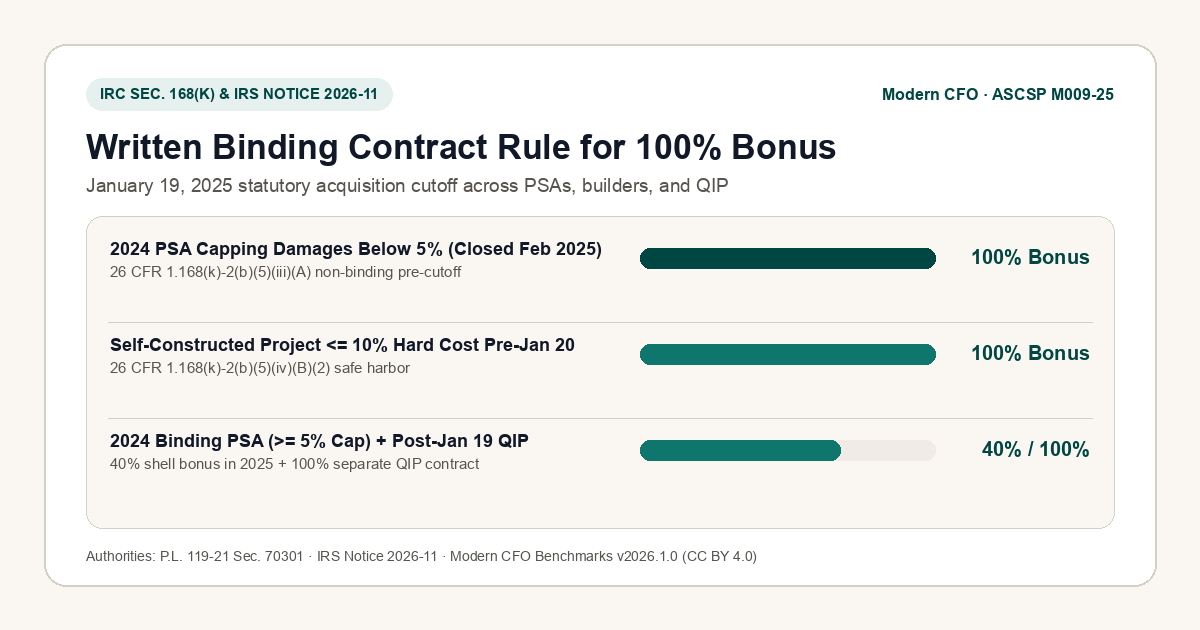
Public Law 119-21 Section 70301 restored permanent 100% bonus depreciation for qualified property acquired and placed in service after January 19, 2025. Under IRS Notice 2026-11 and 26 CFR 1.168(k)-2(b)(5), tax acquisition occurs when a State-law-enforceable written binding contract is executed without capping seller damages below 5% of contract price. A binding agreement signed before January 20, 2025 and placed in service in 2025 pins the acquired building to 40% bonus depreciation (60% for long-production-period property). Non-binding LOIs, options, agreements with sub-5% earnest-money caps, self-constructed buildings within the 10% safe harbor, and post-closing QIP contracts signed after January 19, 2025 earn 100% bonus depreciation.
1. Acquisition Date vs. Closing Date Under P.L. 119-21 Sec. 70301 and Notice 2026-11
Many real estate buyers assume that closing escrow in February 2025 or March 2026 automatically unlocks permanent 100% first-year bonus depreciation for property placed in service after January 19, 2025. Congress wrote a two-prong effective-date test into Section 70301(c) of the One, Big, Beautiful Bill Act (Public Law 119-21, enacted July 4, 2025).
To claim 100% bonus depreciation in 2025 or 2026, qualified 5-year, 7-year, and 15-year MACRS assets must be both acquired after January 19, 2025 and placed in service after January 19, 2025. Section 70301(c)(4) states that property is never treated as acquired after the date on which a written binding contract is entered into for its acquisition. On January 14, 2026, Treasury and the IRS issued Notice 2026-11 to govern this transition. Notice 2026-11 confirms that taxpayers apply the regulatory definitions in 26 CFR 1.168(k)-2(b)(5) and the component election in 26 CFR 1.168(k)-2(c) using January 19, 2025 as the cutoff date.
5% Damages Threshold & Split-Basis Bonus Estimator
Check the 5% binding-contract damages floor and compare Year-1 cost segregation write-offs on a 25% reclassified commercial basis.
| Transaction or Construction Document | Binding Before Jan 20, 2025? | Bonus Rate Branch | Controlling IRC / CFR Authority |
|---|---|---|---|
| PSA executed on or after Jan 20, 2025 and placed in service in 2025 or 2026 | No (Post-Cutoff) | 100% bonus depreciation (acquired after January 19, 2025) | P.L. 119-21 Sec. 70301(a) & (c); IRC 168(k)(1)(A) |
| 2024 PSA with earnest-money forfeiture cap below 5% of contract price, closed in Feb 2025 | No (Damages < 5%) | 100% bonus depreciation (acquired after January 19, 2025) | 26 CFR 1.168(k)-2(b)(5)(iii)(A); IRS Notice 2026-11 |
| 2024 non-binding Letter of Intent or unexercised option, PSA signed after January 19, 2025 | No (Non-Binding) | 100% bonus depreciation (placed in service in 2025 or 2026) | 26 CFR 1.168(k)-2(b)(5)(iii)(C); Notice 2026-11 |
| 2024 PSA with >=5% hard deposit or specific performance, closed and placed in service in 2025 | Yes (Binding Pre-Cutoff) | 40% bonus depreciation in 2025 (60% long production period) | P.L. 119-21 Sec. 70301(c)(4); 26 CFR 1.168(k)-2(b)(5)(ii) |
| Self-constructed building with <=10% hard cost paid/incurred before January 20, 2025 | No (10% Safe Harbor) | 100% bonus depreciation (placed in service in 2025 or 2026) | 26 CFR 1.168(k)-2(b)(5)(iv)(B)(2); Notice 2026-11 |
| Pre-cutoff self-constructed shell with separate HVAC/finish contracts signed after January 19, 2025 | Split via Component Election | 100% bonus depreciation on post-January 19, 2025 components | Notice 2026-11 Sec. 4; 26 CFR 1.168(k)-2(c) |
| Post-closing interior QIP build-out contract signed after January 19, 2025 on a 2024-contracted building | No (Separate Contract) | 100% bonus depreciation on post-January 19, 2025 QIP & 5-yr | IRC 168(e)(6); 26 CFR 1.168(b)-1(a)(5) |
2. The 5% Liquidated-Damages Test Under 26 CFR 1.168(k)-2(b)(5)(iii)(A)
Commercial real estate purchase and sale agreements frequently look binding to a broker while failing the federal tax definition of a written binding contract. Under 26 CFR 1.168(k)-2(b)(5)(iii)(A), an agreement is binding only if it is enforceable under State law against the taxpayer or a predecessor and does not limit damages to a specified amount.
Treasury added an objective bright line inside subparagraph (b)(5)(iii)(A). A clause limiting damages to at least 5 percent of total contract price is treated as uncapped. Conversely, a liquidated-damages clause capping seller recovery below 5 percent of total contract price disqualifies the contract from being binding!
Consider two buyers who each signed a purchase agreement on December 12, 2024 for a $5,000,000 suburban flex-industrial facility ($4,000,000 depreciable building basis excluding land) and closed escrow on February 24, 2025. Under the Modern CFO Cost Segregation Allocation Benchmarks (v2026.1.0, CC BY 4.0), industrial and flex-warehouse facilities reclassify 15% to 28% of depreciable basis (5% to 12% 5-year process electrical and millwork plus 10% to 16% 15-year sitework).
- Buyer A (2% Earnest-Money Sole Remedy = Non-Binding Before Closing). Buyer A posted a $100,000 deposit (2.0% of the $5,000,000 contract price). The default clause makes retaining that $100,000 deposit the seller's sole remedy and waives specific performance. Because 2.0% falls below the 5% regulatory floor ($250,000), no written binding contract existed before title transferred on February 24, 2025, unlocking 100% bonus depreciation in 2025!
- Buyer B (5% Hard Deposit or Specific Performance = Binding on Dec 12, 2024). Buyer B posted a $250,000 non-refundable deposit (5.0% of contract price) as liquidated damages or left the seller free to seek specific performance. Buyer B's written binding contract took effect before January 20, 2025, pinning the acquired property placed in service in 2025 to 40% bonus depreciation plus regular Year-1 MACRS on the remaining 60% short-life balance.
3. Letters of Intent, Purchase Options, and Inspection Contingencies
Deals straddling the January 19, 2025 transition often involve preliminary term sheets, lease-purchase options, due-diligence inspection windows, and financing contingencies. Subparagraphs (b)(5)(iii)(B) and (b)(5)(iii)(C) separate non-binding bilateral negotiations from enforceable commitments.
- Letters of Intent (LOIs) and Term Sheets. Standard commercial LOIs expressly disclaim binding obligation on purchase price and conveyance (except for confidentiality or exclusivity clauses). Signing an LOI in November or December 2024 has zero impact on bonus eligibility when the definitive PSA was executed after January 19, 2025.
- Options to Acquire Property (26 CFR 1.168(k)-2(b)(5)(iii)(C)). An option to purchase real estate is explicitly excluded from the definition of a binding contract. A tenant holding a fixed-price purchase option inside a 2021 triple-net lease only acquires the property when the option is formally exercised. Exercising after January 19, 2025 qualifies eligible assets placed in service in 2025 or 2026 for 100% bonus depreciation.
- Unilateral Free-Look Due Diligence vs. Third-Party Contingencies (26 CFR 1.168(k)-2(b)(5)(iii)(B)). A condition outside both parties' control (such as municipal zoning approval, environmental agency sign-off, or third-party lender appraisal) does not stop a contract from being binding. By contrast, an unrestricted unilateral buyer "free-look" right to terminate for any reason and recover its deposit prevents binding status until that inspection window expires or is waived.
4. Self-Constructed Property, the 10% Safe Harbor, and the Component Election
Developers building ground-up properties or major expansions do not sign a purchase agreement with a seller. Under 26 CFR 1.168(k)-2(b)(5)(iv) and IRS Notice 2026-11, self-constructed property (including buildings constructed for a taxpayer by a general contractor under a turnkey contract) is treated as acquired on the date physical work of a significant nature begins.
Taxpayers do not have to guess when excavation or foundation pouring became "significant." Subparagraph (b)(5)(iv)(B)(2) provides an objective 10% Safe Harbor. Physical work of a significant nature is deemed not to begin until the taxpayer pays or incurs more than 10 percent of total property cost, excluding land and preliminary activities.
Under 26 CFR 1.168(k)-2(b)(5)(iv)(B)(1), preliminary soft costs and site-prep items are excluded from both the numerator and denominator of the 10% test. Excluded items cover architectural and engineering blueprints, soil testing, building permits, financing fees, site clearing, mass grading, and demolition of existing structures.
| Project Cost Category ($8.0M Ground-Up Medical/Flex Build) | Total Budget | Incurred Before Jan 20, 2025 | 10% Safe Harbor Treatment |
|---|---|---|---|
| Land Acquisition | $1,400,000 | $1,400,000 | Excluded from numerator and denominator |
| Architecture, Civil Engineering, Permits & Financing Fees | $520,000 | $490,000 | Preliminary activity: excluded from both |
| Site Clearing, Mass Grading & Old Pad Demolition | $280,000 | $280,000 | Preliminary activity: excluded from both |
| Foundation Footings, Structural Steel, MEP & Interior Finishes | $5,800,000 | $460,000 | Included: $460k / $5,800k = 7.93% (<= 10%) |
| Safe Harbor Result (Placed in Service October 2025) | $8,000,000 | $2,630,000 | Deemed acquired after January 19, 2025: 100% bonus in 2025 |
Even though the developer spent $2,630,000 (32.9% of total project budget) before January 20, 2025, only $460,000 counted as non-preliminary construction cost against the $5,800,000 hard-cost denominator. At 7.93%, the project stayed inside the 10% safe harbor, so all 5-year and 15-year assets segregated when the building is placed in service in 2025 or 2026 qualify for 100% bonus depreciation.
What if the core shell exceeded 10% before January 20, 2025? Under IRS Notice 2026-11 Section 4 and 26 CFR 1.168(k)-2(c), a developer whose larger self-constructed shell began before January 20, 2025 can attach a timely component election to its federal return. That election claims 100% bonus depreciation on qualifying MACRS components (dedicated electrical, process piping, cabinetry, or 15-year site paving) acquired or self-constructed after January 19, 2025 and placed in service in 2025 or 2026.
5. Split-Basis Renovations (15-Year QIP) and Form 3115 DCN 7 Catch-Up
A pre-January 20, 2025 acquisition contract never taints post-closing capital improvements contracted separately. Under 26 CFR 1.168(b)-1(a)(5) and IRC Section 168(e)(6), interior non-structural renovations placed in service after the building was first placed in service are separate MACRS additions.
Suppose an investor signed a binding contract on November 15, 2024 to buy a $6,000,000 office building and closed on February 10, 2025. On March 1, 2025, the investor signed a separate $1,100,000 general contractor contract for interior Qualified Improvement Property (lighting, interior drywall partitions, acoustic ceilings, restrooms, and plumbing branches) plus 5-year specialty millwork.
- Acquired Core Building Shell & Sitework. Governed by the November 15, 2024 written binding contract, 5-year and 15-year components segregated from the purchase price and placed in service in 2025 receive 40% bonus depreciation plus regular Year-1 MACRS on the remaining 60% balance.
- Post-Closing Interior Renovation ($1,100,000). Contracted and acquired after January 19, 2025 and placed in service in 2025 or 2026, every dollar of eligible 15-year QIP and 5-year personal property qualifies for 100% bonus depreciation!
- Transitional & Class Elections. Under IRC Section 168(k)(10)(A) and Notice 2026-11, taxpayers may elect a 40% transitional rate (60% for long-production-period property) only for their first taxable year ending after January 19, 2025. Taxpayers may also elect out of bonus depreciation class-by-class under IRC Section 168(k)(7), such as electing out on 15-year property while claiming 100% bonus on 5-year assets.
What if a CPA already filed a 2025 return booking a building to 39-year straight-line depreciation or applying 40% bonus to a 2024 PSA that had a 2% earnest-money cap? You do not need an amended return. Under Rev. Proc. 2025-23, filing Form 3115 (Designated Change Number 7) claims the missed bonus and MACRS deductions in a single current-year IRC Section 481(a) adjustment. Modern CFO engineering study fees run $1,200 to $2,500 for small residential properties, $2,500 to $6,000 for standard commercial buildings, and $6,000 to $12,000 for large institutional complexes.
6. Frequently Asked Questions
Does a purchase contract signed in 2024 that closed in February 2025 qualify for 100% bonus depreciation?
It depends on the contract's default remedies under 26 CFR 1.168(k)-2(b)(5)(iii)(A). If the 2024 PSA capped seller liquidated damages below 5% of total contract price as the sole remedy, it was not a written binding contract before January 20, 2025, so closing after January 19, 2025 unlocks 100% bonus depreciation in 2025. If damages were uncapped or at least 5%, the acquired building takes 40% bonus in 2025.
Do Letters of Intent (LOIs) or lease purchase options lock in 40% transitional bonus rates?
No. Non-binding LOIs and options to acquire property are excluded from binding contracts under 26 CFR 1.168(k)-2(b)(5)(iii)(C). Executing the definitive PSA or exercising the purchase option after January 19, 2025 qualifies eligible assets placed in service in 2025 or 2026 for 100% bonus depreciation.
How does the 10% safe harbor work for self-constructed buildings straddling January 19, 2025?
Under 26 CFR 1.168(k)-2(b)(5)(iv)(B)(2) and IRS Notice 2026-11, construction is deemed to begin after January 19, 2025 when the taxpayer paid or incurred 10% or less of total hard construction cost before January 20, 2025. Land, architectural/engineering design, permits, financing fees, clearing, grading, and demolition are excluded from both numerator and denominator.
Can post-closing interior renovations get 100% bonus even if the building shell gets 40%?
Yes. Separate general contractor or trade contracts signed after January 19, 2025 for 15-year Qualified Improvement Property (IRC Section 168(e)(6)) and 5-year specialty assets placed in service in 2025 or 2026 receive 100% bonus depreciation independently of the 2024 shell acquisition contract.
Audit Your PSA Default Clause & Segregate Your 2025/2026 Basis
Run a free instant cost segregation estimate for your property type, or explore our statutory engineering guides for specialized commercial real estate.